
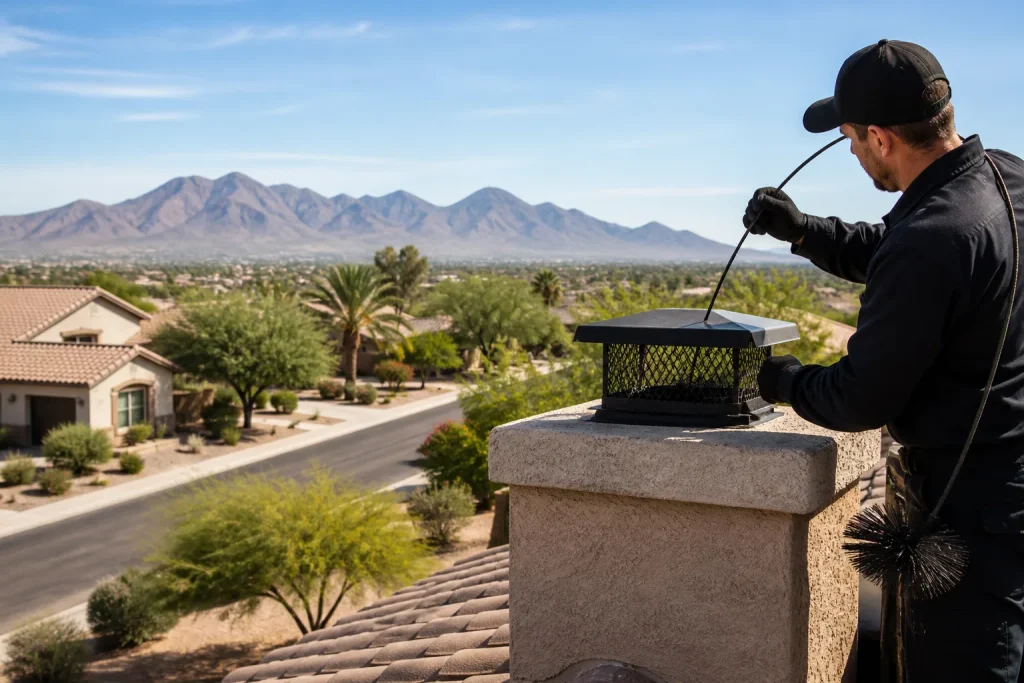
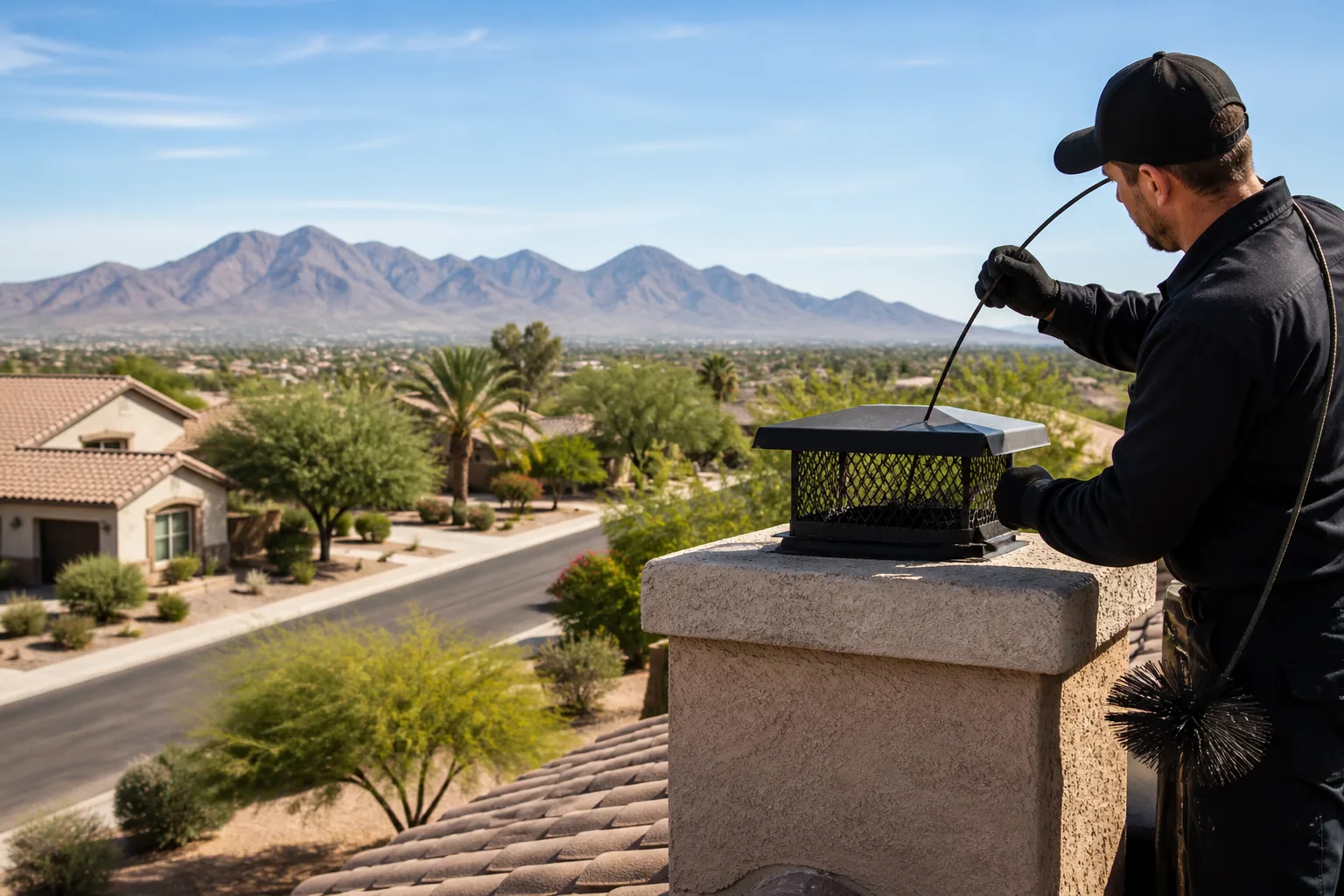
Famco Chimney Sweep in Goodyear: A Homeowner’s Guide
If you searched “FAMCO chimney sweep,” you were probably looking for a chimney cap or damper product, not a company name. Here’s the part that trips people up: FAMCO is a manufacturer of chimney and ventilation components. They don’t sweep chimneys. The cap, damper, flashing, or vent cover on your roof may well carry the FAMCO name, and the person who can tell you whether that part fits your flue is a chimney professional, not the factory. Getting the part right matters. Getting it installed right matters more.
We work with FAMCO components regularly, and we’ve seen how often a good product underperforms because it was sized wrong or sealed with the wrong material. This guide covers what FAMCO actually makes, which configurations suit the rooflines around Goodyear, and what a professional install includes that a weekend project usually skips.
What Does FAMCO Actually Make for Residential Chimneys?
FAMCO manufactures chimney and ventilation products. For a typical home in Goodyear, the relevant categories are chimney caps, draft inducers, top-sealing dampers, and flashing collars. These are the parts that sit at the top of the system and at the roof penetration, and they do the quiet work of keeping weather, animals, and downdrafts out while letting exhaust escape.
Here’s what each one does, in plain terms:
- Chimney caps cover the flue opening. A good cap keeps rain out, stops birds and debris from nesting, and sparks from landing on the roof. It also affects draft by shaping how air moves across the flue mouth.
- Draft inducers address weak or inconsistent draft, often in chimneys with a short stack or an awkward termination. They’re a targeted fix, not a universal add-on.
- Top-sealing dampers close the flue from above rather than at the firebox. When they seal, they seal fully, which cuts heat loss through an open flue and keeps conditioned air where you want it.
- Flashing collars work at the roof penetration, where the chimney meets shingles. This is the joint most likely to leak if it’s done poorly.
What we tell homeowners in Goodyear: none of these parts is complicated on its own. The complication is matching the right product to your specific flue size, roofline, and the way your chimney actually drafts. That’s the diagnosis piece a sweep or inspection provides before anyone orders a part. If you’d rather not sort that out yourself, call (866) 361-8426 and we’ll take a look.
Which FAMCO Cap and Damper Configurations Suit Goodyear Rooflines?
Goodyear has a lot of flat-to-low-slope rooflines, and that changes which cap configuration makes sense. On a low-slope roof, the chimney often terminates with a shorter stack and more exposure to prevailing wind across the roof surface. A cap with the wrong open area or a solid-sided cap that wasn’t matched to the flue can actually make draft worse in that setting.
Here’s how we think about the match:
- Low-slope and flat rooflines: favor single-flue or multi-flue caps with generous open area and a design that sheds wind rather than blocking it. Draft inducers come into play more often here when a short stack won’t pull reliably.
- Steep-pitch roofs: the stack is usually taller and the termination sits higher above the surrounding roof plane. Caps here tend to be selected for rain and animal protection over draft correction, since draft is less often the complaint.
- Top-sealing dampers: a strong fit for both configurations when the goal is reducing heat loss through an idle flue. They need the right gasket and a mounting frame sized to the actual flue tile.
- Flashing collars: matched to the roof material and pitch at the penetration. A collar sized for a low-slope application won’t seal correctly on a steep one.
We specify materials by name because the brand behind the product matters. We work with FAMCO components alongside the trade brands we stock for repairs, and we match the configuration to what the chimney needs rather than what’s easiest to order. For a full look at how we approach the roof-level work on a home in Goodyear, see our Goodyear service page.
Why Does Cap Sizing Create the Draft Problems You’re Trying to Solve?
Improper sizing of a FAMCO cap relative to the flue tile dimensions creates the exact draft problems homeowners are trying to fix. That’s the single most common error we see. A cap that’s too small restricts exhaust flow. A cap that’s too large can allow wind to drive down into the flue. Either way, the symptom looks the same: smoke that won’t go up, a fireplace that seems to fight you, or a faint backdraft smell when the fire isn’t burning.
Here’s what proper sizing accounts for:
- The actual flue tile dimensions. Measured, not estimated. Nominal 8×8 tiles are often not 8×8 in practice, and older masonry especially wanders.
- Free open area. The cap’s airflow openings must be at least as large as the flue cross-section, and ideally sized so wind doesn’t drive down.
- Stack height and termination. A short stack above a low-slope roof behaves differently from a tall one.
- Number of flues. Multi-flue chimneys need a cap sized for the combined arrangement, with enough separation between flues to prevent cross-drafting.
- Adjacent structures and rooflines. A nearby gable or parapet can create turbulence that a generic cap won’t handle.
This is why we don’t hand over a part number without a look at the chimney. Sizing is a measurement job, and the fix for a draft problem is often a correctly sized cap, not a new chimney. In our experience, a camera inspection and a careful measurement at the flue top catches most of these mismatches before anyone spends money on the wrong component.
Stainless Steel vs. Galvanized: What Holds Up in Goodyear?
Stainless steel FAMCO components outperform galvanized alternatives in Arizona’s UV and thermal environment. That’s not a knock on galvanized as a category. It’s a statement about what happens to a coated steel part when it sits on a roof in Goodyear year after year, cycling between intense sun and cooler nights with a lot of UV exposure along the way.
What we see play out over time:
- Stainless steel holds its integrity through sun exposure and temperature swings, keeps its finish, and doesn’t depend on a coating to stay intact. It’s the material we reach for on caps and dampers in this climate.
- Galvanized steel relies on its zinc coating. Once that coating is compromised at a fastener hole, a cut edge, or a seam, the base steel is exposed and the lifespan shortens. In high-UV settings, the coating itself weathers faster than it would in a milder climate.
- Sealant and fasteners matter as much as the metal. A stainless cap with the wrong sealant still fails at the joints.
We stock and specify trade-grade parts from suppliers including Olympia Chimney and Copperfield precisely because material quality is the difference between a cap that lasts and one that’s back on the list in a few seasons. Trade-grade parts. Residential pricing. No generalist shortcuts. If you’re weighing a replacement cap for a Goodyear home, our chimney repair page covers the surrounding work that often comes with it.
What Does a Professional FAMCO Installation Include That DIY Skips?
A professional FAMCO installation includes things a DIY install typically skips: the correct sealant for the roof material and climate, proper fastener torque so the cap or collar seats without distorting, and clearance verification to confirm the component doesn’t interfere with draft or create a hazard. Those three items are where most DIY roof-level jobs fall short.
Here’s what we check on a typical install:
- Sealant type. Not all roof sealants are equal. The right one depends on the roof material, the metal of the component, and the local thermal cycle. The wrong sealant dries out, cracks, or never cures properly.
- Fastener torque and placement. Over-tightening distorts a cap or collar and opens gaps. Under-tightening leaves it loose in wind. Fasteners also need to go into solid material, not just shingles.
- Clearance verification. The cap must clear the flue by the right amount for proper draft and must not sit so close that it restricts flow or traps heat.
- Flashing integration. On a collar install, the flashing has to work with the existing roof membrane and counter-flashing, not just sit on top of it.
- Draft check after install. A simple smoke test or draft reading confirms the new component behaves the way it should before we leave the roof.
This is roof work. A fall from a steep-pitch roof causes serious injury, and a poorly sealed penetration can leak for years before anyone notices. If the chimney is tall, the pitch is steep, or you’re not comfortable on a ladder, that’s the point to hand it to a trained professional. If you’d rather not DIY, call (866) 361-8426. We answer 24/7. Fast dispatch from 7am to 7pm, Sunday through Friday.
When to call a pro: a draft problem that persists after a cleaning, a cap that’s loose or missing, water staining at the chimney or ceiling, or any component replacement on a steep roof. For the routine cleaning side of things, our chimney sweep service covers the flue itself.
Related services in Goodyear: inspection, sweep, and repair are all handled by one specialist team, start to finish. More on the full range at Goodyear Chimney Sweep.
The Bottom Line
FAMCO is a manufacturer of chimney and ventilation components, not a service company. The parts you’ll encounter on a Goodyear home are most likely a cap, a top-sealing damper, a draft inducer, or a flashing collar. Each has a job. Getting the right one depends on measuring the flue, understanding the roofline, and matching material to the local climate. Stainless steel holds up better than galvanized here. And the install details, sealant, fastener torque, clearance, are where the product’s performance is actually decided.
If a cap is loose, a damper won’t seal, or a draft problem won’t go away, that’s a diagnosis job before it’s a parts job. A clean chimney is the starting point. A structurally sound one is the goal.
If you’re in Goodyear and need help, Goodyear Chimney Sweep offers free estimates. Call (866) 361-8426. We answer 24/7. Fast dispatch from 7am to 7pm, Sunday through Friday. Inspected, cleaned, and repaired by one specialist team. Our technicians have up to 8 years of experience, and the written estimate sets the final price.
Frequently Asked Questions
No. FAMCO manufactures chimney and ventilation components, including caps, dampers, draft inducers, and flashing collars. If you need a chimney swept or inspected in Goodyear, that’s a service performed by a chimney professional, not by FAMCO. Call (866) 361-8426 for an exact quote on a sweep or inspection. Estimates are free.
You measure the actual flue tile opening, not the nominal size, and compare it to the cap’s free open area. The cap should allow at least as much airflow as the flue cross-section without letting wind drive down. A cap that’s too small restricts draft; too large can cause backdrafts. Call (866) 361-8426 and we’ll measure it properly. Estimates are free.
Yes, in this climate. Arizona’s UV and thermal cycle weathers galvanized coatings faster than milder climates do, and once the coating is compromised at a seam or fastener, the base steel is exposed. Stainless steel doesn’t depend on a coating to stay intact. Call (866) 361-8426 if you’re weighing a replacement. Estimates are free.
You can, but the details that determine whether it works are the ones most DIY installs skip: the correct sealant, fastener torque, clearance verification, and a post-install draft check. The work is also on the roof, where a fall from a steep pitch causes serious injury. If the pitch is steep or the chimney is tall, hand it to a trained professional. Call (866) 361-8426 for an exact quote. Estimates are free.
Written by the team at Goodyear Chimney Sweep.
Need Chimney Cleaning Help?
Call Goodyear Chimney Sweep - licensed & insured, with free written estimates in Goodyear.
(866) 361-8426